
CoolMax Pro Fusion: skin renewal, lighter downtime.
Dual-wavelength platform for tone, texture, and skin renewal: the lighter-downtime complement to ablative resurfacing, for licensed providers and practice owners.
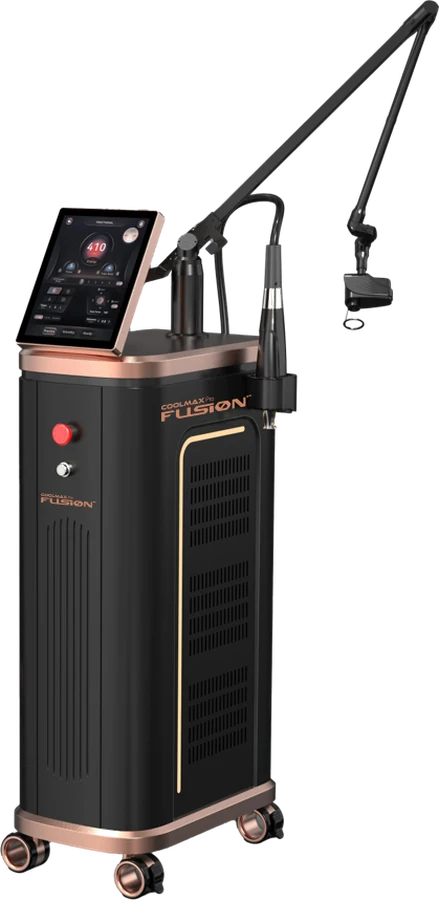
- Modality
- Two laser sources on one console: ablative CO2 at 10,600 nm and micro-ablative thulium at 1,927 nm
- Manufacturer
- Part of the CoolMax Pro series distributed by Solunis Medical. Eventide is a United States distributor, not the manufacturer.
- Regulatory
- Nothing on this page states a clearance for either wavelength. Documentation is provided with the quote.
- What it costs
- Quoted against the two-device alternative. Leasing and financing are structured in the same quote.
The lane beside your ablative platform
Fusion is bought as the lane beside an ablative platform, and it is what fills the days a heavy resurfacing console cannot. It earns that place when your patients want renewal they can schedule around, and the CO2 arm is there for the days deep remodeling is the job.
We sell this one as the companion tier. Most practices run it beside a fractional CO₂, and it books the patients the CO₂ day loses.
Practices adding a lower-downtime lane
- You already run ablative resurfacing and want a lighter-downtime lane beside it.
- Your patients ask for tone and texture work they can book without clearing a week.
- Pigment-prone skin is a real part of your book, and 1,927 nm is why.
- You would rather own one console than an ablative platform and a non-ablative one.
What arrives with the quote
- No clearance is stated anywhere on this page for the CO2 arm or the thulium arm. Current product documentation comes with your quote.
- The full power, spot and fluence ranges for both arms arrive on the manufacturer’s spec sheet with your quote.
- CO2 at 10,600 nm is the deep half of this console, with the longer downtime and post-inflammatory hyperpigmentation profile that ablative work carries; 1,927 nm is the short-downtime half beside it.
- 1,927 nm works at the epidermal-dermal junction, which is why it carries the short-downtime lane; the CO2 arm on the same console is the one that reaches deep dermis.
- Two laser sources means two sets of protocols on one service contract, and the clinical onboarding covers both.
That split is the point: CO2 at 10,600 nm for depth and thulium at 1,927 nm for surface, so one console can run an aggressive resurfacing day and a low-downtime day for the patients who will not accept the first one.
Four questions worth asking us
- What are the power, spot and fluence ranges for each arm? The full spec sheet comes with the quote.
- Which indications ship as presets in Easy Mode, and which have to be built in Advanced?
- What does the documentation supplied with the quote record about this console's status?
- If I already run a fractional CO₂, what does the thulium arm add that I cannot do today?
Two depths, one pass
Fusion exists because 10,600 nm and 1,927 nm cover opposite depths. CO2 delivers full ablative resurfacing and rejuvenation: the deep, high-reward half of the console, with the post-inflammatory hyperpigmentation profile and longer downtime that ablative work carries. Thulium at 1,927 nm targets coagulation and denaturation at the epidermal-dermal junction, used mainly for skin lightening and tone work with short downtime, which is why it is favored for pigment-prone skin.
The console fires both, so a protocol can carry deep dermal remodeling and epidermal-junction work in the same session rather than in two separate visits, and customized dwell times let the provider tailor how much thermal residence each column receives: which is, in practice, how downtime is tuned for a specific patient and calendar. That is the whole architecture: two sources, one combination mode and one parameter set, so there is nothing to configure and nothing to add later.
- CO2 arm10,600 nm
- Ablative: the deep half of the platform, for resurfacing and rejuvenation where full ablation is the intent
- Thulium fiber arm1,927 nm
- Micro-ablative. Coagulation and denaturation at the epidermal-dermal junction with short downtime; providers use it for melasma, resurfacing, rejuvenation, dark circles and intimate whitening
- Dual pulseCO2 + 1,927 nm
- Combination delivery across superficial and deep dermal targets, with customized dwell times tailoring downtime
- Operating modesEasy / Advanced
- Easy Mode presents indication and Fitzpatrick I to VI selection and sets parameters; Advanced Mode exposes energy, power, pulse width, spacing, total points and scan order directly
What the manufacturer states
Specifications are provided by the manufacturer: full spec sheets are included with every quote. The table below carries the published set, and the last row names the figures that arrive on the full spec sheet with your quote.
| Specification | Value |
|---|---|
| Energy and delivery | |
| System | Dual-wavelength skin-renewal platform |
| Wavelengths | CO2 10,600 nm ablative thulium fiber 1,927 nm micro-ablative |
| Delivery | Dual pulse across superficial and deep dermal targets, with customized dwell times |
| Operating envelope | |
| Operating modes | Easy (indication and Fitzpatrick I to VI driven) and Advanced (energy, power, pulse width, spacing, total points, scan order) |
| Focus | Tone, texture & overall skin renewal |
| Positioning, and what arrives with the quote | |
| Positioning | A lighter-downtime complement to ablative resurfacing |
| Supplied with the quote | Full power, spot and fluence ranges for both arms are included on the manufacturer’s spec sheet with every quote. |
Tone and texture without the ablative downtime
Providers position the Fusion as the maintenance-and-renewal lane alongside heavier resurfacing platforms.
- Skin tone
- Dual-wavelength energy providers use for overall tone.
- Skin texture
- Texture and overall skin renewal on the same platform.
- Lighter-downtime lane
- A lighter-downtime complement to ablative resurfacing for patients who can't book recovery time.
- Pairs with CO₂
- Practices often run it alongside a fractional CO₂ for a two-tier resurfacing menu.
What is documented
Four rows, each a supplier statement about the pairing, the workflow, the published specification and the documentation that comes with your quote.
| Source | What it says |
|---|---|
| Wavelength pairing | Supplier statement: ablative CO2 10,600 nm and micro-ablative thulium 1,927 nm on one console with dual-pulse combination delivery. |
| Workflow | Supplier statement: Easy and Advanced modes with Fitzpatrick I to VI selection and per-indication presets. |
| Published specification | The manufacturer supplies full spec sheets with every quote. |
| Product documentation | Current product documentation is provided with every quote. No clearance is stated on this page for the CO2 arm or the thulium arm. |
Specifications are supplied by Solunis Medical. Treatment lists describe how licensed providers use the platform. No patient outcome is claimed or guaranteed. Current product documentation is provided with every quote. What you get is a spec sheet delivered with the quote, so two wavelengths get judged against the treatment days you already have booked rather than against a brochure.
What it costs to buy, and what it costs to run
A laser that sits idle loses money. The support around the device is what turns capital into revenue: handled by the same team that sources your pharmacy and biologics.
two laser sources means two sets of protocols. The onboarding is what keeps this console booked.
- Price and financing
- Platforms like this do not carry a sticker price. Configuration, applicators, training and term all move the number, so the question that actually matters is the monthly. Most device financing here lands near $2,500 per month, pending configuration, credit approval, rates and terms. Tell us which treatments you want on the menu and we work the number back from the revenue they carry. Weighing the options? Read Buy vs. lease your first laser.
- Installation and site prep
- We support clinics in all 50 US states. Site prep, voltage and footprint checks are handled before delivery, and platforms run full-range 110 to 220 V, so they fit most US treatment rooms.
- Clinical training
- Hands-on protocols and KOL-backed education for your staff.
- Warranty and service
- Warranty and service terms are set by the manufacturer and vary by platform: the current terms are included in every quote. Eventide remains your single point of contact after installation.
- Upgrade path
- Start with a base platform and add handpieces or modules as the practice expands.
- Who supplies it
- CoolMax Pro Fusion is part of the CoolMax Pro series distributed by Solunis Medical. Eventide Aesthetics & Wellness is a United States distributor supplying it to licensed providers and practice owners: we handle the quote, the financing, the install and the training, and we stay your point of contact after the sale.
- Who it is sold to
- This is a business-to-business page. CoolMax Pro Fusion is sold to licensed medical providers and the practices they operate, not to consumers, and nothing here is directed at patients.
What buyers ask about the CoolMax Pro Fusion
Is financing available for the CoolMax Pro Fusion?
Yes. Leasing and financing are structured to your practice, with payments you can model against your expected bookings. Every quote includes transparent pricing, financing terms, and an ROI view. If you are weighing purchase against a lease, start with our guide, Buy vs. lease your first laser.
Are training and installation included?
Yes. Site prep, voltage, and installation are handled (full-range 110 to 220V platforms fit most rooms) and clinical onboarding with hands-on protocols and KOL-backed education is included. One point of contact covers quote, install, and training.
What about warranty and support?
Warranty and service terms are set by the manufacturer and vary by platform: the current terms are included in every quote. Eventide remains your single point of contact after installation, coordinating service and support with the same team that handles your other supply lines.
How much does a CoolMax Pro Fusion cost?
Fusion carries two laser sources, so it prices above the single-source CO2 console and below buying an ablative and a non-ablative platform separately. We quote it against the two-device alternative so the comparison is honest. Most practices ask for the monthly rather than the sticker, and device financing here typically lands near $2,500 per month, pending configuration, credit approval, rates and terms.
What is the 1927 nm thulium wavelength used for?
It is micro-ablative rather than ablative: it targets coagulation and denaturation at the epidermal-dermal junction, and providers use it mainly for skin lightening and tone work where short downtime matters. It is the shallower, lower-downtime counterpart to the CO2 arm.
Why combine CO2 and thulium in one device?
Because they cover opposite depths. CO2 delivers deep ablative remodeling with the longer downtime and PIH profile ablative work carries; 1,927 nm works at the epidermal-dermal junction with short downtime. One console lets a provider run either, or both in a dual-pulse protocol, without buying two platforms.
Who distributes CoolMax Pro Fusion in the United States?
Eventide Aesthetics & Wellness distributes CoolMax Pro Fusion to licensed providers and practice owners across all 50 US states. CoolMax Pro Fusion is part of the CoolMax Pro series distributed by Solunis Medical.
How do I buy CoolMax Pro Fusion for my clinic?
Start with a 15 to 20 minute call. We scope your space, budget and treatment menu, then send pricing, financing terms, spec sheets and an ROI view before you commit. After you order, site prep and installation are handled and your staff get hands-on clinical onboarding. Call 813-544-7131 or email justin@eventideaw.com.
Specifications and regulatory status reviewed 24 July 2026 by Justin Messner, Co-Founder, Eventide Aesthetics & Wellness.
Important information for providers. Eventide Aesthetics & Wellness is a distributor. Product specifications are supplied by Solunis Medical. Treatments listed describe how licensed providers use the platform. No treatment outcome is claimed or guaranteed. For licensed medical providers and practice owners.