

Two exosome lines. One vetted source.
Therapeutic biologics for injectable protocols and toxin-free exosomes for aesthetic and topical use, matched to your treatment and state.
- Categories
- Two, each with its own regulatory category and its own protocol. ZEO ScientifiX supplies perinatal and autologous biologics for therapeutic protocols where a state statute covers them; Genovia by BioGenomics is a topical cosmetic exosome preparation for aesthetic use in all 50 states.
- Manufacturers
- ZEO ScientifiX and BioGenomics. Eventide is a distributor, not the manufacturer.
- Regulatory
- The therapeutic line is processed in an FDA-registered, ISO 7, cGMP facility compliant with 21 CFR Part 1271, and therapeutic use depends on whether a state statute covers the format. Product availability and permitted use vary by state and by product.
- What it costs
- Quoted per line, product and volume. Certificates and third-party reports are available for every batch before you buy, not after the order.
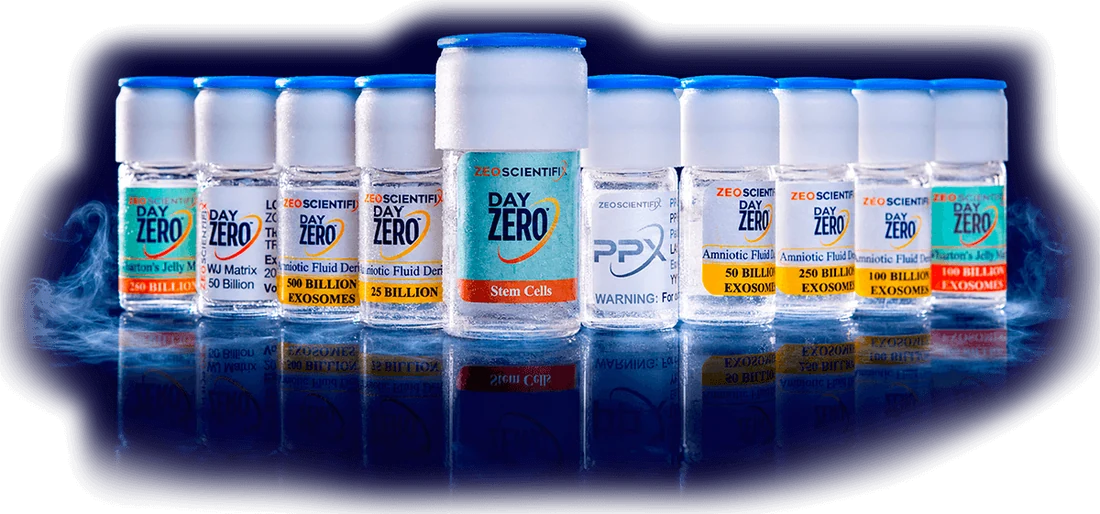
Therapeutic or aesthetic. Start where your practice is
Two different companies, two different regulatory categories. ZEO ScientifiX supplies perinatal and autologous biologics for therapeutic protocols where a state statute covers them. Genovia by BioGenomics is a topical cosmetic exosome preparation for aesthetic use in all 50 states. Most clinics end up carrying both, and we tell you which line each protocol needs before you order.
the certificates are available before you buy, not after the order.
Practices that already run one of the two protocols
- You practise in Florida, Utah, Georgia or Tennessee and want the injectable protocols your state’s statute covers: orthopedic, wound care and pain in Florida; your scope of practice in Utah, Georgia and Tennessee; and, in Tennessee, exosome-based products.
- You want a topical aesthetic line that ships to all 50 states and needs no cold chain.
- Your medical director asks for a Certificate of Analysis, a Certificate of Conformance and donor-eligibility records before an order, not after it.
- You would rather carry both lines from one source than reconcile two vendors' paperwork.
What each category covers
- The topical aesthetic line ships to all 50 states as its own cosmetic line, not as a substitute for the injectable one.
- The injectable line is not intended for intravenous delivery and is not interchangeable with the topical line. Conflating the two is the most common mistake we see.
- The statutory ground moves: Florida’s CS/CS/SB 1768 created FS §458.3245 and §459.0127, effective 1 July 2025, for orthopedic, wound care and pain indications with products that hold live cells after thaw. A 2026 law created §461.011 for podiatric physicians. Confirm current requirements with your own counsel.
- Product availability and permitted use vary by state and by product, and we confirm exactly what ships to your state before anything is quoted.
The terms are unusually legible: a statute you can read in each of the four states, a documented category for each of the two lines, and a distributor whose job is to tell you which line your protocol needs before you order.
Four questions worth asking us
- What can ship to my state, under what conditions, before anything is quoted?
- Which certificates and third-party reports come with the batch I would receive?
- Which line matches the protocol I already run?
- What does the donor-eligibility screening cover, and who performed it?
Two lines, and every format inside them
What each product is made from, the formats it ships in, and where providers use it. Availability and permitted use vary by state and by product. Confirm both for your practice before you order.
Zeo Scientifix
Therapeutic, injectableOrthopedic, wound care and pain, where potency and traceability matter most: the indications Florida’s statute names, with wider scope-of-practice use in Utah, Georgia and Tennessee.
The DayZero™ range: umbilical-cord stem cells and stem cell-derived exosomes, Wharton's jelly matrix, amniotic membrane patches and discs, high-concentration exosomes, plus two autologous lines. Patient Pure X™ and Signature X™, the personalised aesthetic exosome product. Tissue is collected within hours of delivery and processed in an FDA-registered, ISO 7, cGMP facility under 21 CFR Part 1271.
- Exosome concentration
- 25B to 500B EVs / vial
- Formats
- Cryo & lyophilized
- Sources
- Umbilical, amniotic, autologous
- Provider states
- Cell & tissue: FL, UT, GA & TN (FL: live-cell lots). Exosomes: TN, whose law names them. We confirm supply before we quote.
- Range
- Stem cells, Exosomes, Amniotic membrane, PPX, Signature X
Best for injectable & regenerative protocols
Genovia by BioGenomics
Aesthetic, topical, separate company
Topical, post-procedure & microneedling, without a cold chain.
Adipose-derived stem cell exosomes at approximately 2 billion per mL, stabilised with sodium hyaluronate and trehalose. A patented culture step using a natural stimulant is reported to raise exosome secretion more than fourfold, which keeps cell passage counts low; the product is 0.2 µm filtered, characterised by nanoparticle tracking analysis and immunoblotting, then cryogenically freeze-dried at −80 °C, so no cold chain.
- Exosomes per vial
- 2 Billion
- Kit
- 50mg / 5mL + activator
- Yield vs. standard
- +362%
- Storage
- No cold chain
- Range
- Toxin-free, PDRN, Glutathione, FDA / KFDA / GMP
Best for topical & aesthetic add-on revenue
| Product | Source | Formats | Where providers use it |
|---|---|---|---|
| DayZero™ Stem Cells | Umbilical cord | Ready-to-use vials (10M & 20M cells, 2 mL) and bags (100M, 120M & 150M cells) | Orthopedic, pain & wound |
| DayZero™ Stem Cell-Derived Exosomes | Umbilical cord | 25B and 200B EV (1 mL) | Tennessee: aesthetic and therapeutic protocols |
| DayZero™ Wharton's Jelly Matrix | Amniotic mix | 50B & 100B EV (2 mL); 200B EV (1 mL) | Tennessee: aesthetic and therapeutic protocols |
| DayZero™ High-Concentration Exosomes | Amniotic fluid | 250B & 500B EV (1 mL); 150B EV 3-vial box; 25B and 50B EV 5-vial boxes | Tennessee: aesthetic and therapeutic protocols |
| DayZero™ Amniotic Membrane | Amniotic membrane | 12 mm optical discs; 2×2 cm and 2×4 cm patches; custom sizes by cm² | Wound care |
| Patient Pure X™ (PPX™) | Autologous — patient's platelets | 100B, 200B & 400B EV vials | Tennessee: therapeutic protocols |
| Signature X™ | Autologous — patient's platelets | Per-patient; ships with a Total Cell Counter report | Tennessee: aesthetic (skin, hair, post-procedure) |
| Genovia™ | Adipose-derived stem cells | ~2 billion exosomes / mL, lyophilised | Topical aesthetic, microneedling, post-procedure |
ZEO ScientifiX products are processed in an FDA-registered, ISO 7, cGMP facility compliant with 21 CFR Part 1271. The manufacturer states they are not drug products and are not intended to prevent, treat or cure diseases or medical conditions. They are not intended for intravenous delivery. The FDA regulates exosomes used to treat diseases and conditions as drugs and biological products subject to premarket review and approval. The manufacturer’s site is directed to providers in Florida, Utah, Georgia and Tennessee. Their statutes cover cell and tissue products; Florida, Utah and Georgia exclude secreted products such as cell factors, and Florida requires live cells after thaw. Tennessee’s Public Chapter 1016 names exosome-based products; we confirm supply before we quote. Florida’s CS/CS/SB 1768 created FS §458.3245 and §459.0127, effective 1 July 2025, for orthopedic, wound care and pain; confirm current requirements with your own counsel.
Where providers work with these products
Categories where practices in our network apply regenerative and aesthetic products. These are provider-directed use areas, not statements of efficacy: licensed providers determine appropriate use for each patient.
- Application areas
- Aesthetic & skin, Post-procedure care, Microneedling adjunct, Hair & scalp, Topical protocols, Regenerative practice, Orthopedic & sports, Wound & recovery
- 33
- Patents behind the Genovia line
- 57
- Peer-reviewed publications
- 400B
- Peak exosome EVs per Zeo vial
- 1 donor
- 1 batch, 3 passes, no recycled cells
Documented sourcing, manufacturing, and testing
Every record this category is sold on is a record about process: where a product was made, what was in the lot, and who may use it. That is exactly the paperwork a medical director asks for, and it comes with every batch.
| Source | What it says |
|---|---|
| Manufacturing records | The therapeutic line is produced in FDA-registered facilities under cGMP with ISO7 cleanroom standards and 21 CFR Part 1271 compliance; the aesthetic line comes from FDA/KFDA/GMP cell-and-gene manufacturing. Those standards describe how the product was made, and registration is not an FDA approval of the product. |
| Lot documentation | A Certificate of Analysis and Certificate of Conformance for every batch, third-party certified reports, donor-eligibility screening records, and full lot traceability — the paperwork your medical director will ask for, available before you buy. |
| State statutes | Product availability and permitted use vary by state and by product. We confirm what can ship to your state — and under what conditions — before anything is quoted, so there are no surprises after the order. The manufacturer’s site is directed to providers in Florida, Utah, Georgia and Tennessee under those states’ laws; all four statutes cover cell and tissue products, and Tennessee’s also names exosome-based products. A state statute governs who may use a product and where; it is not a federal approval. |
| Patents and publications | The manufacturer profile records 33 patents behind the Genovia line and 57 peer-reviewed publications. |
| Provider use areas | The eight categories listed above are where practices in our network apply these products. The licensed provider determines appropriate use for each patient. |
How this category is actually regulated, and where it is going
Biologics cover three separate things, and knowing which is which is most of the compliance work. We hand you that map before you order.
- Injectable use turns on the product, then the state
- Federal rules apply in every state; on top of them, a growing set of state statutes sets the conditions for a practice, and that list has widened every year. Florida’s CS/CS/SB 1768 took effect 1 July 2025 and permits physicians to administer stem cell therapies that have not been approved by the FDA, limited to orthopedics, wound care and pain management, and conditioned on sourcing from an accredited FDA-registered facility, products that contain viable or live cells after thaw, signed informed consent, and a specific advertising notice. Utah’s S.B. 199 (2024) did the same for placental tissue. Georgia’s governor signed HB 1275 on 11 May 2026 and Tennessee’s governor approved HB 2246 on 19 May 2026, both in force since 1 July 2026 and both tied to the provider’s scope of practice rather than a named list. For a practice, the first question is what the product is. Florida, Utah and Georgia exclude secreted products such as cell factors; Tennessee excludes them from stem cell therapy too, but names exosome-based products in its separate regenerative medicine definition. The second question is what your state’s statute asks of you before a patient is treated.
- What a state statute covers, and what your attorney signs off
- These laws govern the practice of medicine inside their own borders. Federal law is unchanged by them. We will tell you which states have a framework and what it requires; your healthcare attorney tells you what to do with that.
- What an FDA establishment registration covers
- 21 CFR 1271.27(b) puts it in the regulator’s own words: FDA acceptance of an establishment registration and HCT/P listing “does not constitute a determination that an establishment is in compliance with applicable rules and regulations or that the HCT/P is licensed or approved by FDA.” There are currently no FDA-approved exosome products, and exosomes intended for the treatment of disease in humans are regulated as drugs and biological products subject to premarket review. Every facility statement on this page: ours and the manufacturers’. Describes how a product was made.
- Topicals travel a different road entirely
- Under the FD&C Act, cosmetic products and ingredients: colour additives excepted. Require no FDA approval before they go on the market. The Modernization of Cosmetics Regulation Act of 2022 (P.L. 117-328) then built the first real structure around them since 1938: facilities register, products are listed, safety substantiation must be on file, serious adverse events must be reported, and the FDA gained mandatory recall authority. That is a registration-and-listing pathway, not a credential, described by the FDA as “neither a cosmetic approval program nor a promotional tool.” What decides whether a topical is a cosmetic or a drug is intended use, established by the claims made on the label, in advertising and online. That is why we give you a sentence you can use verbatim with your quote pack, and why the wording on the Genovia page is written the way it is: in this category, what you say about a product is what holds its category.
- What the direction of travel means for an operator
- Five states now carry frameworks of this kind: Utah (S.B. 199, 2024), Florida (CS/CS/SB 1768, effective 1 July 2025), Montana (SB 535, signed 13 May 2025, with rules final 25 July 2026), Georgia (HB 1275, signed 11 May 2026) and Tennessee (HB 2246, approved 19 May 2026), and the scope has widened as they have come: from a single tissue source, to a named list of clinical indications, to Georgia and Tennessee tying use to scope of practice, with Tennessee alone among the five naming exosome-based products, and to Montana providing for licensed experimental treatment centres offering therapies that have successfully completed phase 1 of a clinical trial. That is regenerative medicine being written into statute rather than tolerated at the edges of the law. Practices built around regenerative, longevity and performance medicine are being handed more room to operate in than they had two years ago. The ones positioned to use it are the ones whose sourcing records, consent forms and advertising language are already in order, and that documentation is the part we can put in your hands today.
Sources for this section: FDA, Public Safety Notification on Exosome Products (6 December 2019); 21 CFR 1271.10(a) and 1271.27(b); FDA, Is It a Cosmetic, a Drug, or Both?; FDA, Modernization of Cosmetics Regulation Act of 2022; Florida CS/CS/SB 1768 (2025) and CS/CS/SB 1092 (2026), Utah S.B. 199 (2024) and S.B. 55 (2026), Montana SB 535 (2025) and its July 2026 rules, Georgia HB 1275 (2026), Tennessee HB 2246 (Public Chapter 1016, 2026); FDA warning letter to R3 Medical Companies (14 August 2026). Each bill was verified against its own legislature’s record and each rule and letter against the issuing agency’s; every one named here is confirmed from a primary source. Read as of 1 October 2026 and reviewed on the 90-day compliance interval. This is general regulatory information for licensed providers, not legal advice.
What it takes to carry these lines
Every question a compliance-conscious buyer raises on a first call, answered on the page before you have to ask it.
- FDA-registered facilities
- cGMP, ISO7 cleanroom, and 21 CFR Part 1271 compliance across the therapeutic line; FDA/KFDA/GMP cell & gene manufacturing for the aesthetic line.
- Full lot traceability
- Certificate of Analysis, Certificate of Conformance, and third-party certified reports available for every batch, plus donor-eligibility screening.
- State statutes
- Florida, Utah, Georgia and Tennessee each have a statute for this work, with its own conditions: all four cover cell and tissue products (Florida: live cells after thaw), and Tennessee’s also names exosome-based products. Aesthetic exosomes are positioned for topical application. We confirm what can ship to your state, and under what conditions, before anything is quoted.
- Toxin-free production
- Patented filtration yields pure exosomes with no additives: single donor, single batch, three passes, no recycled cell lines.
- Who supplies it
- These lines are made by ZEO ScientifiX and BioGenomics. Eventide is a distributor, not the manufacturer, and handles sourcing, documentation, state matching and support.
- Who it is sold to
- This is a business-to-business page. Both lines are sold to licensed medical providers and the practices they operate, not to consumers, and nothing here is directed at patients. We support clinics in all 50 US states.
What buyers ask before the first order
Are exosome or biologic products FDA-approved?
No. Biologic and exosome products are not FDA-approved to diagnose, treat, cure, or prevent any disease, and no clinical outcome is claimed or guaranteed. That's exactly why documentation and sourcing discipline matter in this category.
What documentation comes with each order?
A Certificate of Analysis and Certificate of Conformance for every batch, third-party certified reports, donor-eligibility screening records, and full lot traceability: the paperwork your medical director will ask for, available before you buy.
How are the products manufactured?
The therapeutic line is produced in FDA-registered facilities under cGMP with ISO7 cleanroom standards and 21 CFR Part 1271 compliance; the aesthetic line comes from FDA/KFDA/GMP cell-and-gene manufacturing.
Can my clinic order in my state?
Product availability and permitted use vary by state and by product. We confirm what can ship to your state, and under what conditions, before anything is quoted, so there are no surprises after the order.
What's the difference between the therapeutic and aesthetic lines?
The therapeutic line is sourced for provider-directed protocols where a state statute covers the format; the aesthetic line covers topical exosome and PDRN products used around aesthetic procedures. Most practices start with the line that matches services they already run: we help you choose on a short call.
Biologic and exosome products are not FDA-approved to diagnose, treat, cure, or prevent any disease. No clinical outcome is claimed or guaranteed. Product availability and permitted use vary by state and by product; we help you match compliant options to your license and jurisdiction.